
Psychosocial and Organizational Determinants of Workplace Injuries: An Analysis Based on De‑Pasquale & Geller’s Interactive Model (1988)
Abstract
Workplace injuries are the result of complex interactions between individual, behavioral, and environmental factors. This article analyzes the foundational model proposed by Jason De‑Pasquale and E. Scott Geller (1988), which conceptualizes injury causation as a dynamic, reciprocal system. Drawing on contemporary safety science and organizational behavior research, the article examines how attitudes, beliefs, risk perception, personality traits, management support, tools, equipment, and safe work practices converge to influence safe or unsafe behaviors. The analysis highlights the relevance of this model for modern safety management systems, behavior‑based safety (BBS), and organizational culture transformation. Implications for industrial operations, particularly in high‑risk environments, are discussed.
Keywords
Safety behavior; injury causation; organizational culture; human factors; De‑Pasquale & Geller; behavior‑based safety.
1. Introduction
Understanding the root causes of workplace injuries is essential for designing effective safety management systems. Traditional approaches often attributed incidents to operator error, but contemporary research emphasizes the interplay between human, behavioral, and environmental determinants. De‑Pasquale and Geller (1988) proposed an influential model that frames injury causation as an interactive, dynamic, and reciprocal system involving the individual, the environment, and behavior. This framework remains highly relevant for industrial operations, especially in sectors where deviations can escalate into severe losses, as illustrated in the training material currently under review .
2. Methods
This article employs a qualitative analytical approach based on:
- Review of the original conceptual model by De‑Pasquale & Geller (1988).
- Comparative analysis with contemporary safety frameworks (BBS, human factors engineering, safety culture).
- Examination of industrial training materials referencing the model, including DuPont’s safety and reliability guidelines .
- Synthesis of academic literature on psychosocial and organizational determinants of safety performance.
3. Results
3.1. Individual Factors
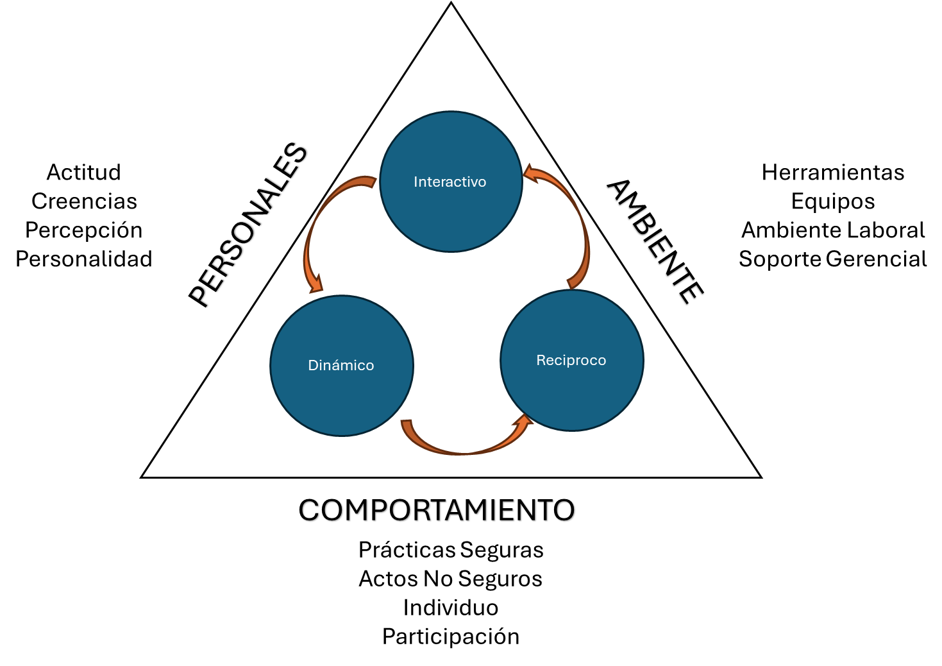
De‑Pasquale & Geller identify four key psychological determinants:
- Attitudes toward safety and risk.
- Beliefs about accident inevitability or controllability.
- Risk perception, which shapes decision‑making under uncertainty.
- Personality traits, such as impulsivity or conscientiousness.
These factors influence how workers interpret hazards and choose between safe and unsafe actions.
3.2. Environmental Factors
The model emphasizes that the physical and organizational environment shapes behavior. Key elements include:
- Tools and equipment (design, reliability, ergonomics).
- Workplace conditions (order, lighting, noise, temperature).
- Safe work practices (procedures, permits, standards).
- Managerial support, which reinforces or undermines safety expectations.
The training material reviewed highlights the critical role of management support and safe practices in preventing deviations and losses .
3.3. Behavioral Factors
Behavior is the convergence point of individual and environmental influences.
- Safe behaviors reduce exposure to hazards.
- Unsafe behaviors (acts and omissions) increase the likelihood of incidents.
- Participation in safety processes strengthens organizational culture.
The model positions behavior as the most modifiable variable, making it central to BBS programs.
3.4. Dynamic Interaction
The three components—individual, environment, behavior—interact continuously.
- The individual interprets the environment.
- The environment reinforces behavior.
- Behavior shapes culture and future perceptions.
This reciprocal causation explains why deviations at the base of the safety pyramid can escalate into severe losses if not addressed proactively.
4. Discussion
The De‑Pasquale & Geller model remains a cornerstone for modern safety management. Its systemic perspective aligns with contemporary frameworks such as:
- Safety culture maturity models
- Human and Organizational Performance (HOP)
- Behavior‑Based Safety (BBS)
- Process Safety Management (PSM)
The model’s emphasis on managerial support resonates with industrial evidence showing that leadership behavior sets the upper limit of safety performance, as noted in the DuPont training material (“the minimum standard established by the leader becomes the maximum level of worker performance”) .
5. Conclusion
De‑Pasquale & Geller’s interactive model provides a robust conceptual foundation for understanding injury causation. By integrating individual, environmental, and behavioral determinants, it supports the design of comprehensive safety programs that address both human factors and organizational systems. Its relevance persists in modern industrial environments where deviations, if unmanaged, can lead to significant operational, environmental, and human losses.
References
De‑Pasquale, J., & Geller, E. S. (1988). Critical factors in injury causation: An interactive model. [Original publication details unavailable; conceptual model widely cited in safety literature].
Geller, E. S. (2001). The psychology of safety handbook. CRC Press.
McSween, T. E. (2003). Value‑based safety process: Improving your safety culture with behavior‑based safety. Wiley.
Reason, J. (1997). Managing the risks of organizational accidents. Ashgate.
📘 Artículo Académico (Versión en Español)
Determinantes Psicosociales y Organizacionales de las Lesiones Laborales: Un Análisis Basado en el Modelo Interactivo de De‑Pasquale & Geller (1988)
Resumen
Las lesiones laborales resultan de interacciones complejas entre factores individuales, conductuales y ambientales. Este artículo analiza el modelo propuesto por Jason De‑Pasquale y E. Scott Geller (1988), que conceptualiza la causalidad de lesiones como un sistema dinámico, recíproco e interactivo. A partir de literatura contemporánea en seguridad industrial y comportamiento organizacional, se examina cómo las actitudes, creencias, percepción del riesgo, rasgos de personalidad, soporte gerencial, herramientas, equipos y prácticas seguras influyen en la ocurrencia de actos seguros o inseguros. Se discute la relevancia del modelo para la gestión moderna de la seguridad, la seguridad basada en el comportamiento (BBS) y la transformación cultural en organizaciones industriales.
Palabras clave
Comportamiento seguro; causalidad de lesiones; cultura organizacional; factores humanos; De‑Pasquale & Geller; seguridad basada en el comportamiento.
1. Introducción
Comprender las causas fundamentales de las lesiones laborales es esencial para diseñar sistemas de gestión de seguridad eficaces. En contraste con enfoques tradicionales centrados en el “error humano”, el modelo de De‑Pasquale & Geller (1988) plantea que las lesiones emergen de la interacción entre individuo, ambiente y comportamiento. Este enfoque aparece explícitamente en el material de formación industrial actualmente revisado y continúa siendo un referente para la gestión de desviaciones y pérdidas.
2. Metodología
El análisis se basa en:
- Revisión del modelo conceptual original.
- Comparación con marcos contemporáneos (BBS, factores humanos, cultura de seguridad).
- Análisis del material de entrenamiento industrial que cita el modelo .
- Síntesis de literatura académica sobre comportamiento seguro y desempeño organizacional.
3. Resultados
3.1. Factores Individuales
Incluyen:
- Actitudes frente a la seguridad.
- Creencias sobre la inevitabilidad o controlabilidad de los accidentes.
- Percepción del riesgo.
- Rasgos de personalidad.
Estos factores condicionan la interpretación del entorno y la probabilidad de ejecutar actos inseguros.
3.2. Factores Ambientales
El entorno físico y organizacional influye directamente en el comportamiento:
- Herramientas y equipos.
- Condiciones de trabajo.
- Prácticas seguras y procedimientos.
- Soporte gerencial.
El material revisado destaca la importancia del liderazgo visible y la disciplina operativa para prevenir desviaciones .
3.3. Factores Conductuales
El comportamiento es el punto de convergencia:
- Actos seguros o inseguros.
- Participación en procesos de seguridad.
- Cumplimiento disciplinado de procedimientos.
3.4. Interacción Dinámica
Los tres elementos interactúan de manera continua y recíproca, generando patrones que pueden fortalecer o debilitar la cultura de seguridad.
4. Discusión
El modelo de De‑Pasquale & Geller se alinea con tendencias actuales como HOP, BBS y PSM. Su énfasis en el liderazgo coincide con la evidencia industrial que muestra que el estándar mínimo establecido por la gerencia determina el máximo nivel de desempeño del equipo, como se indica en el material de DuPont .
5. Conclusiones
El modelo interactivo ofrece una comprensión integral de la causalidad de lesiones y constituye una base sólida para programas de seguridad que integren factores humanos y organizacionales. Su vigencia es evidente en entornos industriales donde las desviaciones pueden escalar rápidamente hacia pérdidas significativas.
Referencias
De‑Pasquale, J., & Geller, E. S. (1988). Critical factors in injury causation: An interactive model.
Geller, E. S. (2001). The psychology of safety handbook. CRC Press.
McSween, T. E. (2003). Value‑based safety process: Improving your safety culture with behavior‑based safety. Wiley.
Reason, J. (1997). Managing the risks of organizational accidents. Ashgate.
Comments are closed.