
An invitation to rethink, relearn, and lead through RCA
Abstract
Root Cause Analysis (RCA) is no longer a reactive tool—it is becoming a strategic system for resilience, prediction, and organizational learning. This article explores the emerging trends that are reshaping RCA and offers a roadmap for professionals who want to lead this transformation. From data-driven diagnostics to human-centered causality, RCA is evolving into a pillar of governance, culture, and operational excellence.
Keywords
Root Cause Analysis, Predictive Maintenance, Human Factors, Organizational Learning, Resilience, Governance, Operational Excellence
🔍 Why RCA matters more than ever
In a world of increasing complexity, RCA is not just about solving problems—it’s about understanding systems, preventing failures, and building resilient organizations. The future belongs to those who can connect data, behavior, and strategy into a unified causal framework.
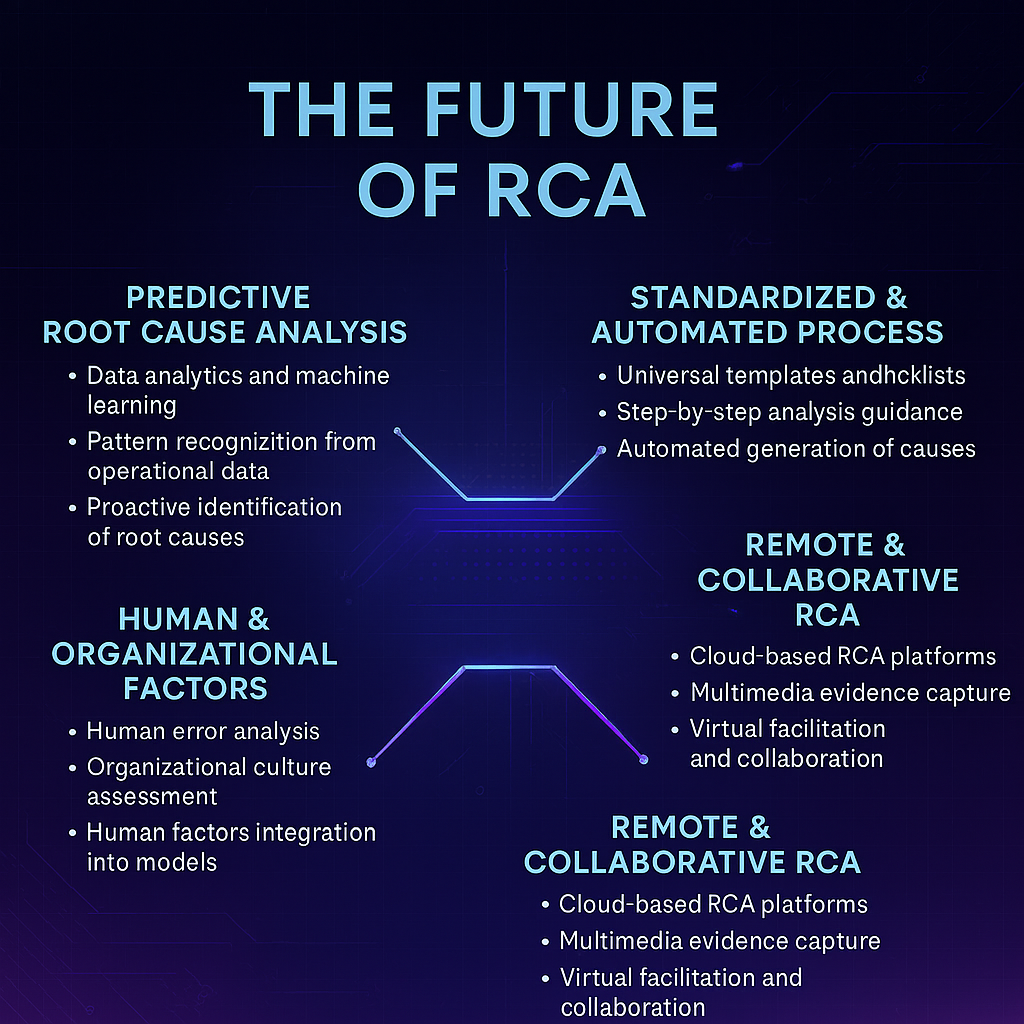
🚀 Seven trends shaping the future of RCA
- Predictive RCA
RCA begins before the failure. With machine learning and condition monitoring, we identify degradation patterns and act proactively (Jardine et al., 2006; Lee et al., 2015). - Human & Organizational Factors (HOF)
Beyond technical causes, RCA now integrates cognitive load, governance, and culture (Reason, 1997; Dekker, 2014). - Standardization & Automation
Templates, guided workflows, and AI-assisted diagnostics reduce variability and accelerate insights (Gano, 1999; ISO 14224:2016). - Integration with Management Systems
RCA becomes part of risk, safety, and asset governance (ISO 31000; ISO 55000; CCPS, 2018). - Advanced Visualization & Executive Narratives
Dashboards, causal maps, and storytelling connect technical findings to strategic decisions (Tufte, 2001; Few, 2012). - Remote & Collaborative RCA
Cloud platforms enable global teams to investigate, document, and learn together (IEEE 1516; Safety Science, 2021). - Resilience-Oriented RCA
The goal is not just to eliminate causes, but to design systems that absorb variability and adapt (Hollnagel, 2011; Leveson, 2012).
🎓 How to prepare for this future
- Learn advanced RCA methodologies (FTA, Bow-Tie, STAMP).
- Develop skills in data analytics and human factors.
- Master facilitation and executive communication.
- Integrate RCA into governance and learning systems.
- Use RCA not to find blame—but to build capability.
📣 A call to action
RCA is no longer a tool—it’s a mindset. It’s a way to lead, to learn, and to transform. Whether you’re an engineer, a manager, or a strategist, the future of RCA invites you to think deeper, connect broader, and act smarter.
Let’s build organizations that don’t just fix problems—they understand them, prevent them, and grow stronger because of them.
📚 References (APA 7th Edition)
- Dekker, S. (2014). The Field Guide to Understanding Human Error. Ashgate.
- Gano, D. L. (1999). Apollo Root Cause Analysis: A New Way of Thinking. Apollonian Publications.
- Hollnagel, E. (2011). Resilience Engineering in Practice. CRC Press.
- ISO 31000:2018. Risk Management – Guidelines.
- ISO 55000:2014. Asset Management – Overview, Principles and Terminology.
- Jardine, A. K. S., Lin, D., & Banjevic, D. (2006). A review on machinery diagnostics and prognostics implementing condition-based maintenance. Mechanical Systems and Signal Processing, 20(7), 1483–1510.
- Leveson, N. (2012). Engineering a Safer World: Systems Thinking Applied to Safety. MIT Press.
- Reason, J. (1997). Managing the Risks of Organizational Accidents. Ashgate.
- Tufte, E. R. (2001). The Visual Display of Quantitative Information. Graphics Press.
Aquí tienes la versión en español, Victor, con el mismo tono inspirador, académico y editorial que la versión en inglés. Está lista para publicación, integración en cursos, capítulos o como artículo motivacional para tu ecosistema ENGYKO.
🌐 El futuro del Análisis de Causa Raíz: de la reacción a la resiliencia
Una invitación a repensar, reaprender y liderar con RCA
Resumen
El Análisis de Causa Raíz (RCA) ha dejado de ser una herramienta reactiva. Está evolucionando hacia un sistema estratégico de resiliencia, predicción y aprendizaje organizacional. Este artículo explora las tendencias emergentes que están transformando el RCA y ofrece una hoja de ruta para los profesionales que desean liderar esta evolución. Desde diagnósticos basados en datos hasta causalidad centrada en el factor humano, el RCA se convierte en un pilar de gobernanza, cultura y excelencia operacional.
Palabras clave
Análisis de Causa Raíz, Mantenimiento Predictivo, Factores Humanos, Aprendizaje Organizacional, Resiliencia, Gobernanza, Excelencia Operacional
🔍 ¿Por qué el RCA es más relevante que nunca?
En un mundo cada vez más complejo, el RCA no se trata solo de resolver problemas. Se trata de comprender sistemas, prevenir fallas y construir organizaciones resilientes. El futuro pertenece a quienes pueden conectar datos, comportamiento y estrategia en un marco causal unificado.
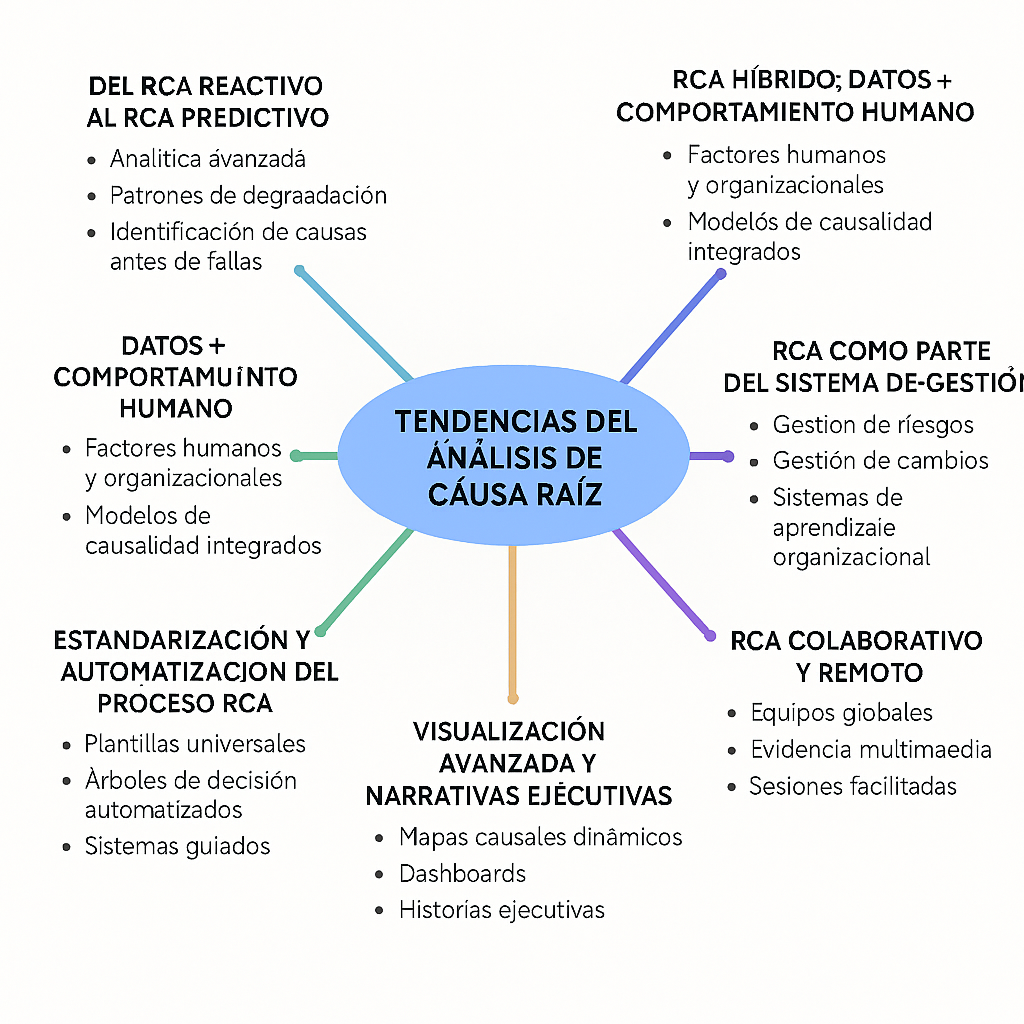
🚀 Siete tendencias que están redefiniendo el RCA
- RCA predictivo
El RCA comienza antes de la falla. Con aprendizaje automático y monitoreo de condición, se identifican patrones de degradación y se actúa proactivamente (Jardine et al., 2006; Lee et al., 2015). - Factores humanos y organizacionales (HOF)
Más allá de las causas técnicas, el RCA integra carga cognitiva, gobernanza y cultura (Reason, 1997; Dekker, 2014). - Estandarización y automatización
Plantillas, flujos guiados y diagnósticos asistidos por IA reducen la variabilidad y aceleran los hallazgos (Gano, 1999; ISO 14224:2016). - Integración con sistemas de gestión
El RCA se convierte en parte de la gestión de riesgos, seguridad y activos (ISO 31000; ISO 55000; CCPS, 2018). - Visualización avanzada y narrativas ejecutivas
Dashboards, mapas causales y storytelling conectan hallazgos técnicos con decisiones estratégicas (Tufte, 2001; Few, 2012). - RCA colaborativo y remoto
Plataformas en la nube permiten que equipos globales investiguen, documenten y aprendan juntos (IEEE 1516; Safety Science, 2021). - RCA orientado a la resiliencia
El objetivo no es solo eliminar causas, sino diseñar sistemas que absorban variabilidad y se adapten (Hollnagel, 2011; Leveson, 2012).
🎓 Cómo prepararse para este futuro
- Dominar metodologías avanzadas (FTA, Bow-Tie, STAMP).
- Desarrollar competencias en analítica y factores humanos.
- Fortalecer habilidades de facilitación y comunicación ejecutiva.
- Integrar el RCA en sistemas de gobernanza y aprendizaje.
- Usar el RCA no para buscar culpables, sino para construir capacidad.
📣 Un llamado a la acción
El RCA ya no es una herramienta. Es una mentalidad. Es una forma de liderar, aprender y transformar.
Ya seas ingeniero, gerente o estratega, el futuro del RCA te invita a pensar más profundo, conectar más amplio y actuar con mayor inteligencia.
Construyamos organizaciones que no solo resuelvan problemas, sino que los comprendan, los prevengan y se fortalezcan gracias a ellos.
📚 Referencias (APA 7ª edición)
- Dekker, S. (2014). The Field Guide to Understanding Human Error. Ashgate.
- Gano, D. L. (1999). Apollo Root Cause Analysis: A New Way of Thinking. Apollonian Publications.
- Hollnagel, E. (2011). Resilience Engineering in Practice. CRC Press.
- ISO 31000:2018. Gestión de riesgos – Directrices.
- ISO 55000:2014. Gestión de activos – Principios y terminología.
- Jardine, A. K. S., Lin, D., & Banjevic, D. (2006). Revisión sobre diagnóstico y pronóstico de maquinaria en mantenimiento basado en condición. Mechanical Systems and Signal Processing, 20(7), 1483–1510.
- Leveson, N. (2012). Engineering a Safer World: Systems Thinking Applied to Safety. MIT Press.
- Reason, J. (1997). Managing the Risks of Organizational Accidents. Ashgate.
- Tufte, E. R. (2001). The Visual Display of Quantitative Information. Graphics Press.
Comments are closed.